
Hair loss affects more people — and at younger ages — than most expect. The process is slow and quiet: a few more strands in the shower, a little less volume, a hairline that keeps shifting back. By the time it feels significant, it’s been happening for months. What makes it harder is that most solutions only work on the surface. Oils, shampoos, and supplements can improve how hair looks — but they don’t reach the follicles where the real problem lives.
That’s where laser caps come in. They represent a genuine shift in how we approach hair thinning — using low-level light therapy to stimulate follicle activity from within, all from the comfort of home.
What You Need to Know Before Reading On
Why Hair Loss Happens in the First Place
The Reality Behind Hair Thinning
Many people start noticing hair loss far earlier than expected. It begins subtly — a little more hair in the drain, reduced volume, a hairline that looks different in photos. Because the changes are gradual, they’re easy to dismiss. By the time they feel significant, the process has often been underway for months. Chronic stress, poor sleep, nutritional gaps, and environmental exposure all accelerate what genetics set in motion.
What’s Happening Inside Your Scalp
Hair grows through three phases: a growth phase where hair actively lengthens, a transition phase where growth slows, and a resting phase where the strand falls out. In a healthy scalp, most follicles spend the majority of time in the growth phase — keeping hair thick and dense.
When hair loss begins, the growth phase shortens, the resting phase extends, and new hair grows thinner with each cycle — a process called miniaturization. Left untreated, follicles can eventually stop producing visible hair altogether. This is why early action matters.
Why Most Solutions Don’t Work Long-Term
Surface treatments — shampoos, serums, oils — can improve how hair looks but don’t address follicle-level disruption. Supplements support overall health slowly. Medications can stimulate growth chemically but require ongoing commitment and carry their own side effects.
The core problem: most treatments operate at a surface level while the real issue requires reaching the follicles beneath. Technology-based solutions emerged specifically to bridge this gap.
What Is a Laser Cap?
A laser cap is a wearable device that looks like a regular cap but contains internal components that emit therapeutic light directly onto the scalp. There’s no product to apply, no pills to take. Light energy does the work — delivered consistently across the scalp during short sessions a few times per week.
Where the Technology Comes From
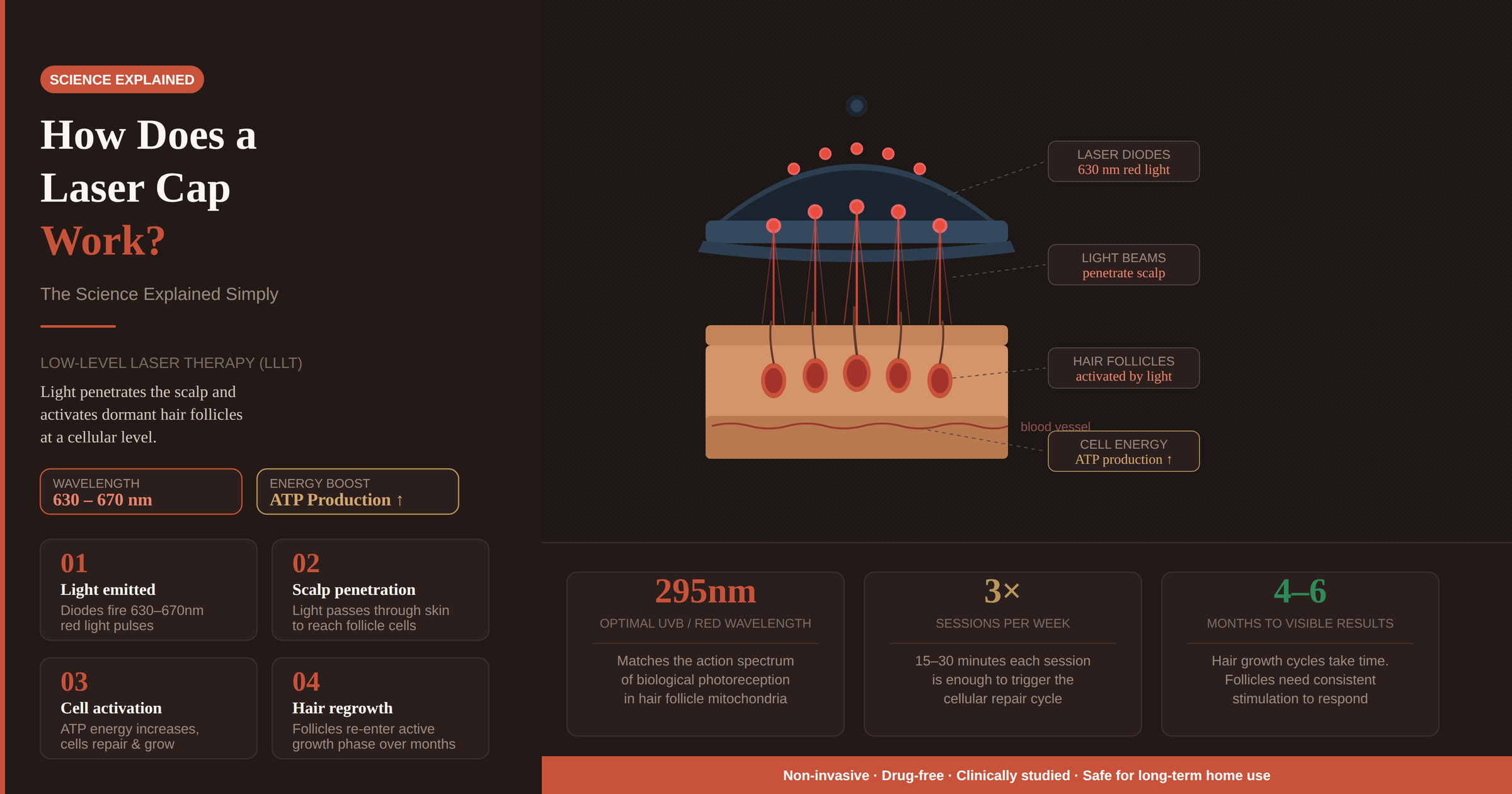
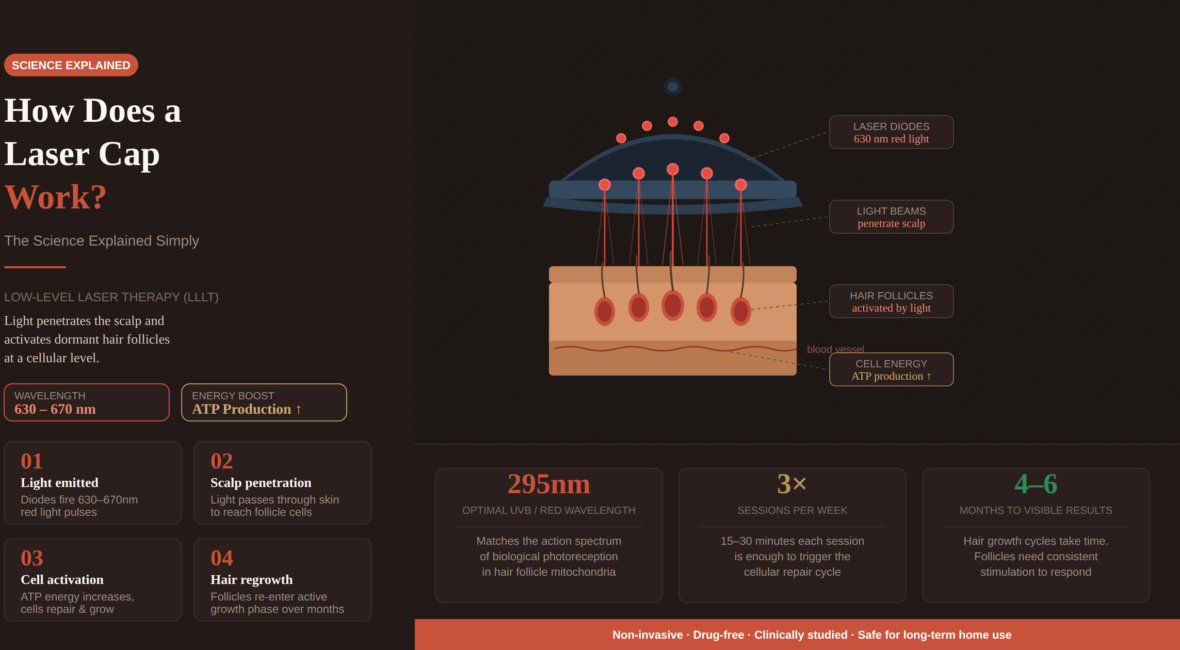
The underlying technology is Low-Level Laser Therapy (LLLT), originally developed for wound healing and inflammation reduction. During early clinical research, scientists noticed that areas exposed to specific wavelengths of light showed improved hair growth. Further investigation confirmed that targeted light energy could positively influence follicle activity — and what once required a clinic visit is now available in a portable wearable device.
What’s Inside a Laser Cap
- Laser diodes or LEDs emitting light at 630–670 nm
- A structured inner lining for uniform scalp coverage
- A rechargeable power system
- An automated timer that controls session length
“The cap design has become the most popular format in light therapy — because ease of use is what actually drives results.”
The Science: How Light Affects Your Scalp
When light in the 630–670 nm range reaches the scalp, it’s absorbed by follicle cells — triggering biological processes that support growth. The primary effect is increased ATP production: ATP is the cell’s energy currency, and more of it means follicle cells can perform growth and repair more efficiently. Simultaneously, scalp blood circulation improves, delivering more oxygen and nutrients. Local inflammation — which can suppress follicle function — also reduces over time.
What Changes Over Time
1–2
Hair fall begins to slow. Follicles become more active. Scalp health improves with better circulation.
3–4
Hair strands feel noticeably thicker. More follicles enter the growth phase. Early volume improvements.
5–6+
Hair density improves with more strands actively growing. Thickness and strength clearly better.
Benefits of Using a Laser Cap
- Non-invasive and painless — no recovery time, no discomfort, no surgical risk
- Supports natural hair growth — works with your body’s own processes
- Improves hair thickness over time — follicles produce stronger, healthier strands
- Enhances scalp blood circulation — delivers oxygen and nutrients more efficiently
- Convenient for regular use — short sessions done at home, hands-free
- Safe for long-term use — no harsh chemicals or aggressive procedures
- Even full-scalp coverage — all areas receive consistent stimulation
Who Should Use a Laser Cap
Laser caps are most effective for people in the early to moderate stages of hair thinning — where follicles are still active and capable of responding to stimulation.
Ideal Users
- Those experiencing early-stage thinning or increased hair fall
- People noticing reduced volume or finer strands without full bald patches
- Individuals with stress-related or lifestyle-driven hair fall
- Anyone preferring a non-invasive, medication-free approach
Who May See Limited Results
- Completely bald areas where follicles are no longer active
- Advanced hair loss with long-term miniaturization
- People unable to commit to consistent weekly use
Top Brands: iRestore, Kiierr & IllumiFlow
Three brands consistently lead in the laser cap space. Each takes a different approach in technology, design, and ideal user.
iRestore
Combines laser diodes with LEDs for broader coverage and deeper penetration. Structured helmet-style design with high diode counts.
Kiierr
100% medical-grade laser technology. Flexible wearable cap that feels natural. Shorter sessions and lightweight build for daily consistency.
IllumiFlow
Straightforward cap design at an accessible price. Multiple models for different stages of thinning. Beginner-friendly.
| Feature | iRestore | Kiierr | IllumiFlow |
|---|---|---|---|
| Technology | Laser + LED | Laser only | Laser only |
| Design | Structured helmet | Flexible cap | Minimal cap |
| Best For | Tech-focused users | Daily comfort & use | Beginners, budget |
| Price Range | $600–$1,800+ | $750–$1,500+ | $500–$1,200+ |
IllumiFlow 272
Great entry-level option. Simple, reliable, beginner-friendly.
Kiierr Laser Cap
Best daily comfort, medical-grade lasers only, shorter sessions.
iRestore Professional
Hybrid laser + LED, maximum coverage and technology.
Safety, Side Effects & Limitations
Laser caps are considered safe because LLLT operates at low intensity — no heat generation, no tissue damage. Unlike surgical lasers, these devices are designed for gentle, repeated stimulation over long periods.
Possible Side Effects
- Mild scalp sensitivity — as the scalp adjusts to increased stimulation
- Temporary shedding — weaker hairs fall out ahead of stronger regrowth
- Slight dryness or warmth — usually resolves quickly, not a sign of harm
Who Should Exercise Caution
- Those with active scalp infections or severe psoriasis
- People taking photosensitizing medications
- Those who are pregnant (consult a doctor first)
- Anyone with sudden or patchy hair loss needing medical diagnosis
A Realistic, Science-Backed Approach to Hair Thinning
Laser caps aren’t a miracle. They’re a consistent, low-effort method that works with your biology. Start early, stick with it, and combine with good nutrition and scalp hygiene for best results.
Frequently Asked Questions
How long does it take to see results?
Most users notice reduced hair fall and improved texture within 2–3 months. Visible improvements in thickness and density typically require 4–6 months of consistent use.
Can laser caps completely regrow hair?
They can support regrowth where follicles are still active. They are significantly less effective in fully bald areas where follicles have stopped functioning.
Is it safe for long-term use?
Yes. Laser caps use low-intensity light and do not involve invasive procedures or harsh chemicals, making them suitable for extended use when following recommended guidelines.
Can they be used alongside other treatments?
Generally yes — laser caps support natural processes and are compatible with most topical and supplemental hair care routines. Check with your doctor if you’re on medication.
Do they work for both men and women?
Yes. The mechanism of follicle stimulation applies similarly across genders, though individual response may vary.
What happens if you stop using the cap?
Since the treatment doesn’t permanently alter follicle behavior, consistent use is needed to maintain results. Stopping will gradually reduce the supportive effects over time.
Is daily use required?
No — most devices are designed for 3 sessions per week. Daily use is generally not recommended and isn’t more effective than the scheduled protocol.